1. GREETINGS AND FAREWELLS - SALUDOS
- edinsonsalazar6
- 10 ene
- 6 min de lectura

Actualizado: 28 ene
PLANIFICACION DIDACTICA
Fase de la Estrategia | Herramientas y Dinámica | Objetivo de Aprendizaje |
1. Introducción Visual | VIDEO (LSV - ENGLISH) | Captar la atención y conectar el signo visual con el sonido del inglés. |
2. Mediación Lingüística | CLASS (ESPAÑOL - LSV - ENGLISH) | Explicar conceptos usando el español como puente entre la seña y el idioma extranjero. |
3. Vocabulario Base | FLASH CARDS | Asociación de imagen, palabra escrita en inglés y su seña correspondiente. |
4. Fonética y Gesto | PRONUNCIACIÓN + SEÑAS | Sincronizar el movimiento de las manos con la articulación correcta de los sonidos. |
5. Aplicación Práctica | PRACTICE (TRILINGÜE) | Ejercicios de repetición donde se alterna entre los tres códigos. |
6. Interacción Real | ROLE PLAYING (VIDEO) | Simulacros de conversación grabados integrando voz y señas (Speaking). |
7. Entrenamiento Auditivo | DICTADO - LISTENING | Identificación de sonidos y palabras para mejorar la comprensión auditiva. |
8. Producción Escrita | ACTIVITY (READING & WRITING) | Traducción de textos para reforzar la gramática y la ortografía del español e inglés. |
9. Ludificación | GAME (MEMORIA) | Juegos de emparejamiento para consolidar el vocabulario de forma divertida. |
10. Verificación | TEST (EVALUACIÓN) | Medición del progreso en las tres áreas lingüísticas. |
11. Inmersión Cultural | CANCIONES (ENGLISH) | Práctica del ritmo, la fluidez y la expresión emocional. |
VIDEO
CLASS - VOCABULARY
ESPAÑOL
ENGLISH
Español | Inglés | Pronunciación Figurada | Glosa LSV (Señas) |
Hola | Hello / Hi | /je-lóu/ - /jái/ | HOLA |
Buenos días | Good morning | /gud mór-ning/ | BUENOS + DÍAS |
Buenas tardes | Good afternoon | /gud áf-ter-nun/ | BUENAS + TARDES |
Buenas noches | Good evening | /gud ív-ning/ | BUENAS + NOCHES |
¿Cómo estás? | How are you? | /jáu ar iú/ | ¿CÓMO? + TÚ + ESTAR |
Mucho gusto | Nice to meet you | /náis tu mít iú/ | MUCHO + GUSTO |
Bien, gracias | Fine, thank you | /fáin zank iú/ | BIEN + GRACIAS |
Por favor | Please | /plis/ | POR FAVOR |
Adiós / Chao | Goodbye / Bye | /gud-bái/ - /bái/ | ADIÓS |
Hasta luego | See you later | /si iú léi-ter/ | HASTA + LUEGO |
Hasta mañana | See you tomorrow | /si iú tu-mó-rou/ | HASTA + MAÑANA |
Cuídate | Take care | /téik kéar/ | CUIDARSE |
LENGUA DE SEÑAS


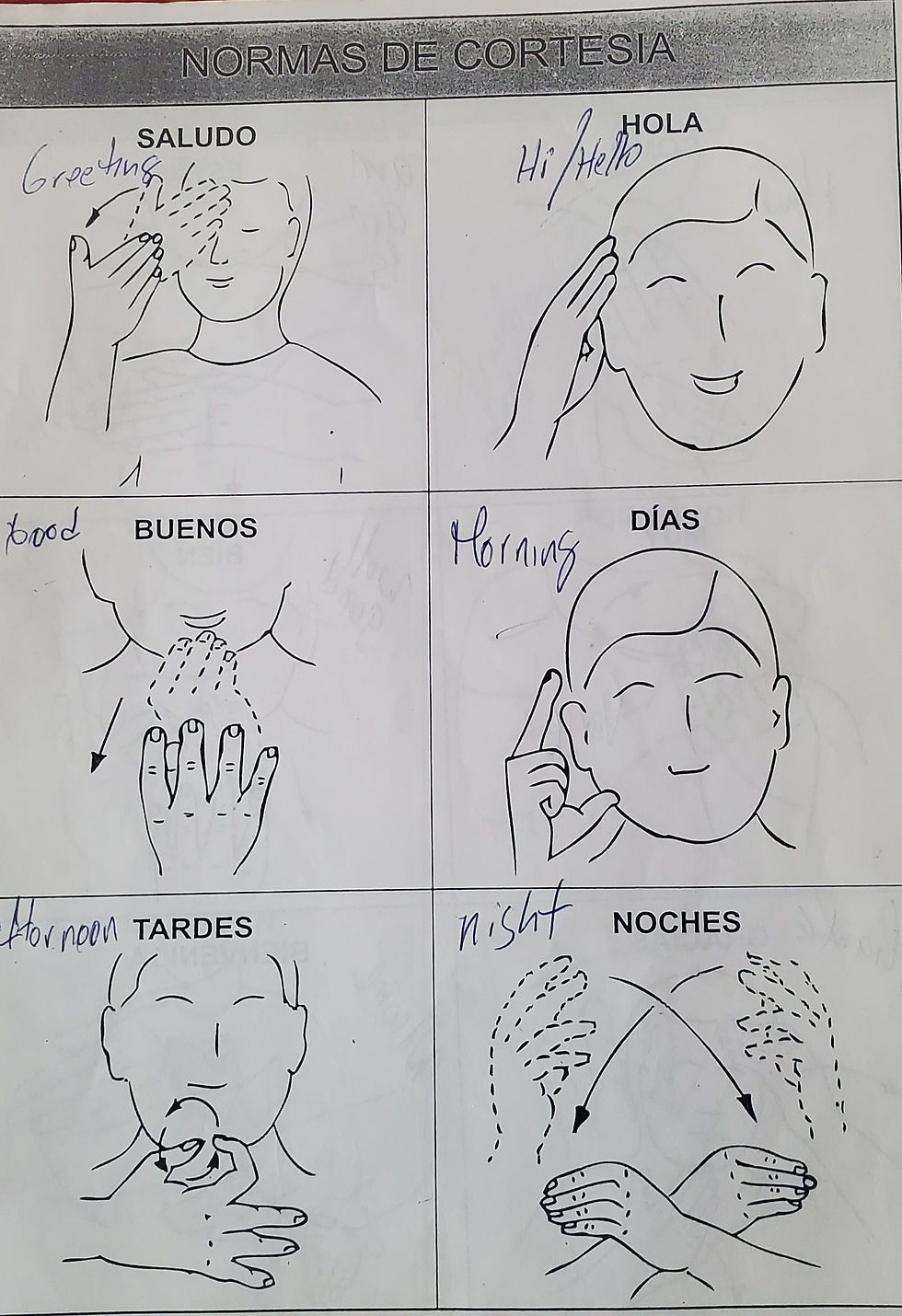
PRACTICA ENGLISH - SPANISH
🤝 Oraciones de Cortesía: Práctica Trilingüe
ESPAÑOL
ENGLISH
Oración en Español | Oración en Inglés | Vocabulario Clave (Señas) |
1. Hola, ¿cómo estás? | Hello, how are you? | Hola + ¿Cómo estás? |
2. Buenos días, profesor. | Good morning, teacher. | Buenos días + Profesor |
3. Gracias por la ayuda. | Thank you for the help. | Gracias + Ayudar |
4. Por favor, siéntate. | Please, sit down. | Por favor + Sentar |
5. Disculpe, no sé. | Excuse me, I don't know. | Disculpe + No sé |
6. Permiso, voy a pasar. | Excuse me, I'm passing. | Permiso + Ir |
7. De nada, amigo. | You're welcome, friend. | De nada + Amigo |
8. Perdón, olvidé la tarea. | Sorry, I forgot the homework. | Perdón + Olvidar + Tarea |
9. Buenas noches a todos. | Good night, everyone. | Buenas noches + Todos |
10. Mucho gusto en conocerte. | Nice to meet you. | Mucho gusto + Conocer |
CONVERSACIONES ROL PLAYING ( ENGLISH - LSV - ESPAÑOL)
Diálogo: En el Salón de Clase (In the Classroom)
ESPAÑOL
ENGLISH
Personaje | Oración en Español | Oración en Inglés | Pronunciación Figurada | Glosa para Señas (LSV) |
Estudiante | Hola, ¿cómo estás? | Hello, how are you? | /je-lóu, jáu ar iú/ | HOLA + ¿CÓMO ESTÁS? |
Profesor | Buenos días, profesor. | Good morning, teacher. | /gud mór-ning, tí-cher/ | BUENOS DÍAS + PROFESOR |
Profesor | Por favor, siéntate. | Please, sit down. | /plis, sit dáun/ | POR FAVOR + SENTAR |
Estudiante | Perdón, olvidé la tarea. | Sorry, I forgot the homework. | /só-ri, ái for-gót de jóum-uork/ | PERDÓN + OLVIDAR + TAREA |
Estudiante | Disculpe, no sé. | Excuse me, I don't know. | /eks-kiús mi, ái dóunt nóu/ | DISCULPE + NO SÉ |
Profesor | Gracias por la ayuda. | Thank you for the help. | /zánk iú for de jelp/ | GRACIAS + AYUDAR |
Profesor | De nada, amigo. | You're welcome, friend. | /iú ar uél-kam, frend/ | DE NADA + AMIGO |
Invitado | Permiso, voy a pasar. | Excuse me, I'm passing. | /eks-kiús mi, áim pá-sing/ | PERMISO + IR |
Estudiante | Mucho gusto en conocerte. | Nice to meet you. | /náis tu mit iú/ | MUCHO GUSTO + CONOCER |
Todos | Buenas noches a todos. | Good night, everyone. | /gud náit, é-vri-uán/ | BUENAS NOCHES + TODOS |
ACTIVITY READING - PUNTO ACUMULADOS -TRADUCIR AL ESPAÑOL
TRADUCIR AL ESPAÑOL
📖 Reading: A Busy Day at School
It is 8:00 AM. Lucas walks into the classroom. He sees his teacher and says, "Good morning, teacher." The teacher smiles and replies, "Hello, how are you?" Lucas sits at his desk, but the teacher says to the whole class, "Please, sit down."
Suddenly, Lucas remembers something. He says, "Sorry, I forgot the homework." The teacher is kind and helps him understand the lesson. Lucas is confused by a question and says, "Excuse me, I don't know the answer." After the teacher explains it, Lucas says, "Thank you for the help.
Later, Lucas meets a new student named Maria. Lucas says, "Nice to meet you." Maria helps him find his books, and Lucas says thanks again. Maria replies, "You're welcome, friend."
At the end of the day, the hallway is crowded. Lucas needs to get to the bus, so he says, "Excuse me, I'm passing." Finally, as he leaves the school, he waves to his classmates and says, "Good night, everyone.
📝 Comprehension Questions (Preguntas de Comprensión)
1. What does Lucas say to the teacher at 8:00 AM?
a) Good night.
b) Good morning, teacher.
c) Nice to meet you.
2. Why is Lucas sorry?
a) Because he is late.
b) Because he forgot the homework.
c) Because he is passing.
3. What does Lucas say when he doesn't have an answer?
a) Excuse me, I don't know.
b) Thank you for the help.
c) Please, sit down.
4. How does Maria respond when Lucas thanks her?
a) Hello.
b) You’re welcome, friend.
c) Good night.
5. What is the last thing Lucas says before leaving?
a) Hello, how are you?
b) Excuse me, I’m passing.
c) Good night, everyone.
ANSWER
GAME (MEMORIA)
TEST
🎧 Listening Activity: "Born to Be"
Instrucciones: Escucha la canción y llena los espacios en blanco utilizando las palabras del Banco de Opciones. Algunas palabras se repiten.
Word Bank (Banco de Opciones):
GHOST - QUEEN - SIDES - PLACE - LIVES- PAID - HIDIN' - SHININ' - BELIEVE - DREAMIN' - THRONE - FAR - LIVES- MOMENT - GLOWING - TIME- GOLDEN - VOICES - FEARS - ALONE
Fill in the Blanks (Completa los espacios):
I was a (1) __________, I was (2) __________, hah
I was a ghost, I was alone, hah
Given the (3) __________, I didn't know how to (4) __________
I was the (5) __________ that I'm meant to be
I lived two (6) __________, tried to play both (7) __________
But I couldn't find my own (8) __________
Called a problem child 'cause I got too wild
But now that's how I'm getting (9) __________, kkeuteopsi on stage
I'm done (10) __________
Now I'm (11) __________ like I'm born to be
We (12) __________ hard, we came so (13) __________, now I believe
We're goin' up, up, up, it's our (14) __________
You know together we're (15) __________
Gonna be, gonna be (16) __________
Oh, up, up, up with our (17) __________
yeong-wonhi kkaejil su eomneun
Gonna be, gonna be golden
Oh, I'm done hidin'
Now I'm shinin' like I'm born to be
Oh, our (18) __________, no (19) __________, no (20) __________
That's who we're born to be
DICTADO
🎧 Dictado de Expresiones Comunes (English Dictation)
N° | Oración en Inglés | Pronunciación Figurada | Traducción al Español | Glosa Señas (LSV) |
1 | Hello, how are you? | /je-lóu, jáu ar iú/ | Hola, ¿cómo estás? | HOLA + ¿CÓMO ESTÁS? |
2 | Good morning, teacher. | /gud mór-ning, tí-cher/ | Buenos días, profesor. | BUENOS DÍAS + PROFESOR |
3 | Please, sit down. | /plis, sit dáun/ | Por favor, siéntate. | POR FAVOR + SENTAR |
4 | Sorry, I forgot the homework. | /só-ri, ái for-gót de jóum-uork/ | Perdón, olvidé la tarea. | PERDÓN + OLVIDAR + TAREA |
5 | Excuse me, I don't know. | /eks-kiús mi, ái dóunt nóu/ | Disculpe, no sé. | DISCULPE + NO SÉ |
6 | Thank you for the help. | /zánk iú for de jelp/ | Gracias por la ayuda. | GRACIAS + AYUDAR |
7 | You're welcome, friend. | /iú ar uél-kam, frend/ | De nada, amigo. | DE NADA + AMIGO |
8 | Excuse me, I'm passing. | /eks-kiús mi, áim pá-sing/ | Permiso, voy a pasar. | PERMISO + IR |
9 | Nice to meet you. | /náis tu mit iú/ | Mucho gusto en conocerte. | MUCHO GUSTO + CONOCER |
10 | Good night, everyone. | /gud náit, é-vri-uán/ | Buenas noches a todos. | BUENAS NOCHES + TODOS |
Comentarios